 September 07, 2026 - BY Admin
Running a successful business requires careful planning, consistent effort, and the ability to adapt to changing market conditions. Whether it is a small startup or a large organization, every business needs a clear strategy to achieve its goals and build long-term success.
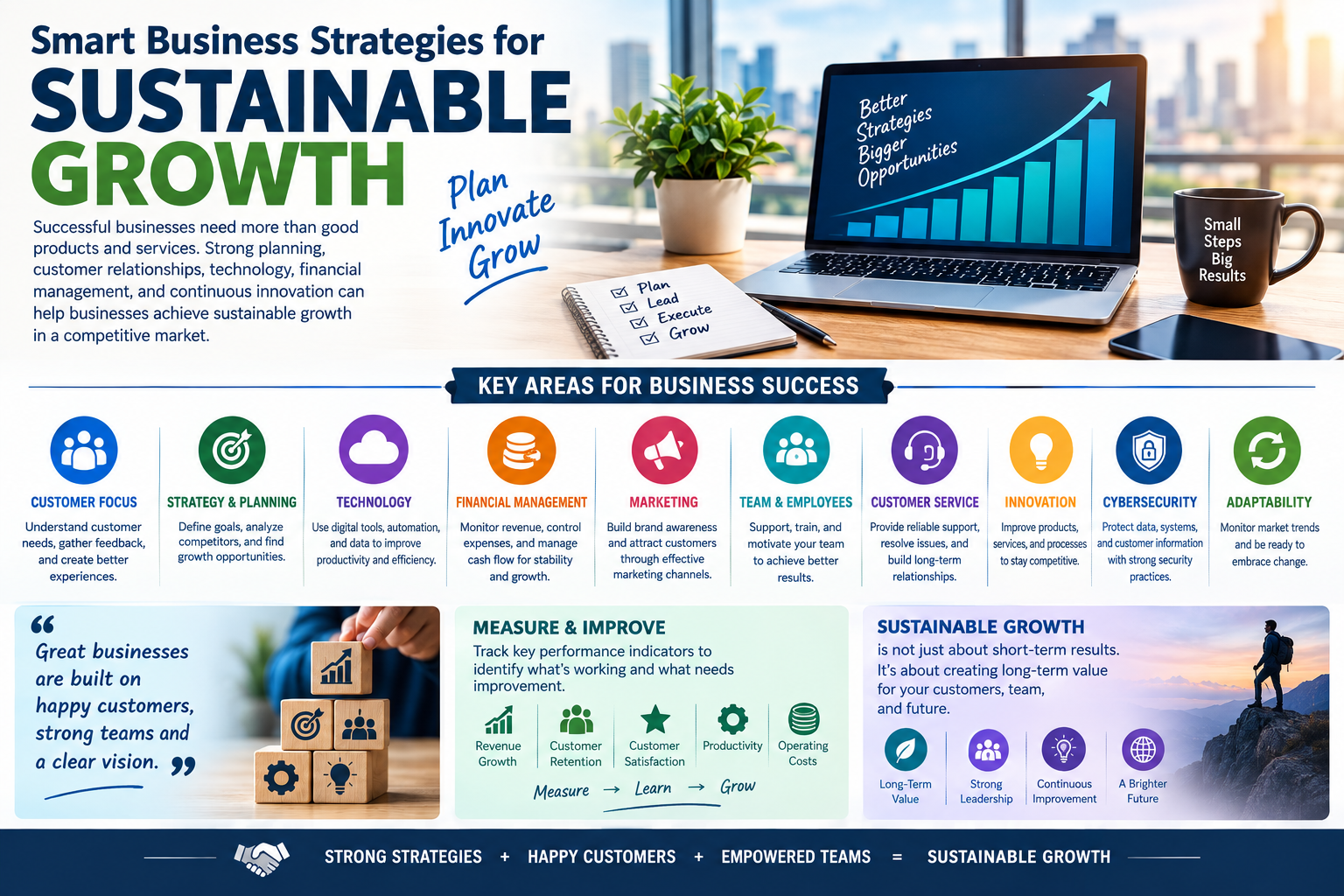
One of the most important aspects of business growth is understanding customers. Businesses should identify customer needs, preferences, expectations, and common challenges. Customer feedback, reviews, surveys, and market research can help organizations improve their products and services while creating better customer experiences.
A clear business strategy provides direction. Companies should define their goals, understand their target market, analyze competitors, and identify opportunities for growth. A well-planned strategy also helps businesses make better decisions about investments, marketing, staffing, and technology.
Technology has become an essential part of modern business operations. Cloud computing, automation, artificial intelligence, analytics, collaboration tools, and digital platforms can help organizations improve productivity and manage their operations more efficiently. Choosing technology based on actual business needs can provide long-term value.
Financial management is another key factor in business success. Businesses need to monitor revenue, expenses, cash flow, budgets, and investments. Maintaining accurate financial records and controlling unnecessary expenses can help organizations remain stable and prepare for future growth.
Marketing plays an important role in attracting new customers and building brand awareness. Businesses can use websites, social media, email marketing, search engine optimization, online advertising, and content marketing to reach their target audiences. Consistent and useful communication can help businesses establish credibility and maintain customer interest.
A strong team is also essential for business success. Skilled and motivated employees can contribute ideas, solve problems, improve processes, and deliver better services. Businesses can support their teams through training, professional development, effective communication, and recognition of employee achievements.
Customer service can have a significant impact on a company's reputation. Customers expect businesses to respond to questions, resolve problems, and provide reliable support. Providing a positive experience can increase customer satisfaction and encourage long-term relationships.
Innovation allows businesses to remain competitive. Companies should continuously look for ways to improve their products, services, processes, and customer experiences. Innovation does not always mean creating something completely new; even small improvements can make a meaningful difference.
Cybersecurity is increasingly important for businesses that depend on digital systems. Protecting customer information, financial records, business applications, and internal data requires appropriate security practices. Strong passwords, multi-factor authentication, access controls, software updates, employee awareness, and regular backups can help reduce security risks.
Businesses should also be prepared to adapt to change. Consumer preferences, technologies, economic conditions, and competitors can change quickly. Organizations that monitor market trends and remain flexible are better positioned to respond to new challenges and opportunities.
Measuring business performance helps organizations understand whether their strategies are producing results. Important indicators may include revenue growth, customer retention, sales performance, productivity, operating costs, and customer satisfaction. Regularly reviewing these measures can help businesses identify areas that need improvement.
Sustainable business growth is achieved through a combination of strong leadership, customer focus, financial discipline, technology, innovation, and continuous improvement. Businesses that focus on creating long-term value rather than only short-term results can build stronger foundations for the future.
Ultimately, successful business management is an ongoing process. Companies need to understand their customers, support their employees, manage resources responsibly, embrace useful technology, and adapt to changing market conditions. With the right strategies and consistent execution, businesses can create lasting value and achieve sustainable growth.